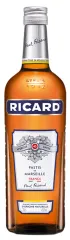
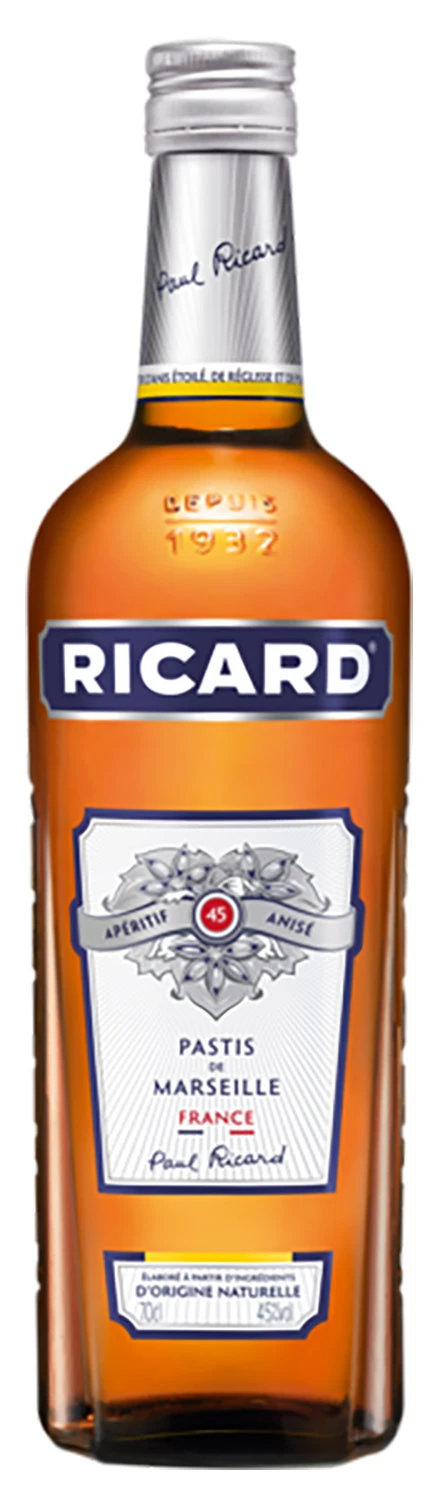
Ricard is a Pastis de Marseille from the south of France, an aniseed-liquorice aperitif with an ABV of 45%, created in Marseille by Paul Ricard in 1932. The Marseille native Paul Ricard created this pastis in 1932 and sold it as "the real pastis from Marseille". The pastis de Marseille category has its own legal footing: by definition, pastis is a spirit drink with an aniseed flavour, additionally containing liquorice root aroma, less than 100 grams of sugar per litre and bottled at a minimum of 45% for pastis de Marseille.
Ricard's recipe has remained unchanged since its creation. The secret recipe has not changed since it was devised by Paul Ricard in 1932, and it stands out for the quality and diversity of its natural ingredients, including star anise, fennel anise, liquorice and aromatic herbs from Provence. The producer indicates the origin of the raw material: pastis de Marseille is made from anise obtained exclusively from fresh plants, grown by local producers in Haute-Provence in the south of France. The label lists water, alcohol, sugar, natural liquorice extracts, anise, caramelised sugar and a blend of aromatic plants.
Ricard's profile is dominated by expressive anise with liquorice, supported by herbs. On the nose there is a green, almost grassy note against a backdrop of sharp anise and liquorice. On the palate intense yet dry anise unfolds, with a hint of fennel and herbal complexity, soft liquorice and a minty-citrus freshness, while the finish is long, herbal and liquorice-driven. In the bottle the drink has a clear, golden-amber colour, and it turns cloudy once water is added.
The characteristic cloudiness is a physicochemical effect. Pastis-type drinks turn cloudy when diluted because they contain oils known as terpenes, which are soluble in a solution containing 30% ethanol or more; below that threshold the terpenes become insoluble, forming a dispersion of oil droplets that gives the liquid its cloudy appearance. Due to the sensitivity of anethole, Ricard also has storage requirements: it should be kept above 12°C and away from direct light, as at lower temperatures the anethole begins to crystallise, which impairs the appearance and taste of the product.
The traditional way of serving it has become established as a ritual. Ricard is classically served in a ratio of one part to five parts of chilled water with ice, whereby, given anethole's sensitivity to cold, the water is added first and the ice cubes a moment later. The producer specifies the proportions: to obtain the right taste, use 2 cl of Ricard and 5 to 7 volumes of water. The drink is best enjoyed fresh: to savour Ricard to the full, it should be consumed within three years of purchase. It pairs well with Mediterranean cuisine, including seafood and olive tapenade.