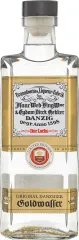
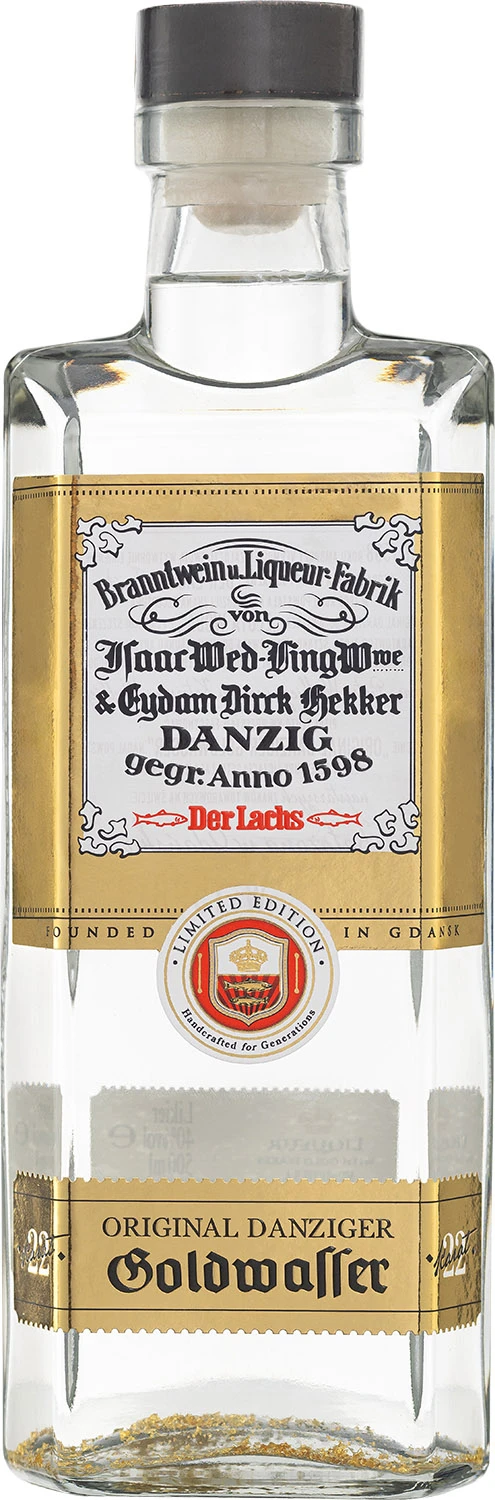
Original Danziger Goldwasser is a spiced herbal liqueur produced in Germany, whose hallmark is the tiny flakes of 22-carat gold suspended in the clear spirit. It is a traditional spiced herbal liqueur from Central Europe, distinguished by the suspension of fine decorative flakes of 23-carat gold.
The brand's history dates back to the turn of the 16th and 17th centuries. The drink's inventor was Ambrosius Vermöllen, who obtained citizenship of Danzig (today's Gdańsk) in July 1598, and whose distillery bore the image of a salmon (German: Lachs) on its façade, from which the brand took its name Der Lachs zu Danzig. The best-known spirit, Original Danziger Goldwasser, appeared in 1606 and quickly became the drink of noble society. Today Goldwasser is produced by the Hardenberg-Wilthen distillery in Nörten-Hardenberg, Germany; the recipe was created in 1606 at the Der Lachs distillery in Danzig, and production was moved to Germany in 1971.
The spirit is based on a complex blend of herbs and spices. The drink has a strength of 40% and is flavoured with herbs and spices such as cardamom, cloves, cinnamon, lavender, thyme, coriander and juniper, with a syrupy texture. Around twenty roots and herbs were combined to create Goldwasser, and the recipe was kept strictly secret and passed down from generation to generation. The signature gold flakes have their roots in the Renaissance belief in the properties of the precious metal. Alcoholic solutions were used by artists for gilding, which is considered the inspiration for the drink; alchemy, at its peak in the late 16th century, attributed many desirable properties to gold, and native gold is non-toxic to humans and passes through the digestive system.
The flavour profile is dominated by notes of anise, cinnamon and citrus. On the palate Original Danziger Goldwasser is spicy and piquant, though not burning, and the secret recipe yields flavours of anise, black liquorice and citrus. The finish is warm and tart, with prickling pepper and lingering cinnamon, while the herbal notes slowly fade into a clean, spiced conclusion.
Goldwasser is traditionally served as a digestif. It is served chilled, poured slowly so that the gold flakes swirl in the glass, and also works well over ice or with a splash of cold water, which opens up its herbal complexity. As a pairing, it goes well with desserts and mature cheeses – dark chocolate emphasises the warm spices and the liquorice note, almond biscotti echo the herbal sweetness, and a mature Gouda or Comté stand up to the pronounced botanical profile.