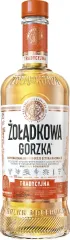
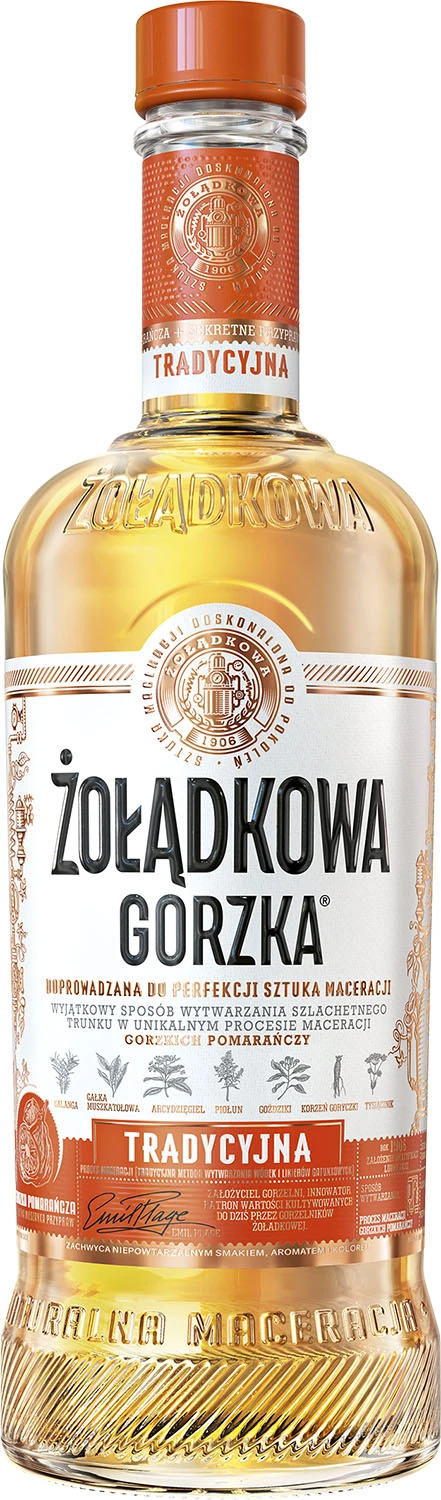
Żołądkowa Gorzka Tradycyjna is a Polish herbal vodka produced by Stock Polska, with an ABV of 36% and a characteristic amber colour. It stands out for its original taste and recipe, whose history dates back to the 19th century, as well as for being the only major brand still made by natural maceration, drawing on the tradition of old Polish herbal cordials.
The brand originates from Lublin's distilling traditions. Its prototype was an old stomach vodka developed in 1822, and the Lublin industrialist Emil Plage founded the first spirit rectification plant in Lublin, which soon took up the production of Żołądkowa Gorzka. Today the spirit is made at the Polmos Lublin distillery, currently run by Stock Polska.
The foundation of its profile is a bitter orange macerate and a blend of spices. Żołądkowa Gorzka is made from natural macerates of bitter oranges from Haiti and a mixture of spices, prepared so that the alcohol combines with the ingredients and draws out the fullness of their aroma and flavour. Production uses a macerate of bitter orange (Citrus aurantium) and a secret blend of spices, while the golden colour and sweet notes come from the addition of caramel; the producer partly reveals the composition, listing among others galangal rhizome, nutmeg, angelica, wormwood, cloves, centaury and yellow gentian root.
Its sensory profile is dominated by the contrast between sweetness and bitterness. Despite its name, this is a sweet vodka of amber colour, with a spicy aroma and herbal taste. On the nose there are notes of candied orange peel, caramel, cloves and other herbs. Sweet, herbal and slightly piquant notes combine on the palate, and its uniqueness stems from the traditional maceration of natural ingredients – bitter oranges, caramel and a secret blend of spices – in special vats.
The spirit should be well chilled before serving. Its natural production method and multi-layered flavour profile mean that Żołądkowa Gorzka is sometimes used as an ingredient in highball, collins or sour cocktails, as well as an alternative to orange liqueurs in classic recipes such as the Margarita, White Lady or Sidecar. As a digestif it pairs well with rich, full-flavoured dishes – from roast meats to desserts with a hint of orange and chocolate.