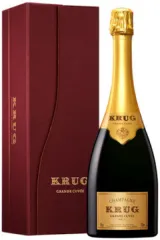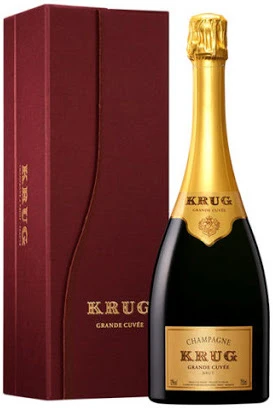
Krug Grande Cuvée is a non-vintage champagne from the Champagne appellation, built around the idea of blending many vintages rather than a single harvest. Krug Grande Cuvée is always a blend of more than 120 individual wines from more than 10 different vintages. It is the most recognisable wine of Maison Krug – the house was founded in Reims in 1843, and each year a new Édition of this champagne is created.
The wine is composed of three grape varieties: Pinot Noir, Chardonnay and Meunier, in proportions that vary from edition to edition. A distinguishing feature of Grande Cuvée is the high proportion of reserve wines from the house's rich library. What makes Grande Cuvée exceptional is the remarkably high proportion of reserve wines (usually 30–50%) and their extraordinary age. The fruit of a single harvest usually forms the base, while reserve wines from earlier years complete the blend, giving it breadth and roundness.
Krug works at the level of individual plots, vinifying and storing each lot separately. The reserve wines are kept as separate components in small lots, held apart until they are used in the blend; each of these lots is usually a single variety from a single vineyard and a single vintage, and after vinification they are stored in stainless steel tanks. Another distinct feature of the style is its approach to malolactic fermentation. Krug neither prevents malolactic fermentation nor induces it, though most of its wines do not undergo the process. Once bottled, the wine spends a long time in the cellar. The house's flagship champagne, Krug Grande Cuvée, remains in the cellars for at least six years.
In its sensory profile, Grande Cuvée combines maturity with crispness. The wine has a deep golden colour and fine, lively bubbles. On the nose and palate, fruity, citrus and bready notes lead the way, supported by long ageing on the lees. On the nose, Krug is distinguished by toasty, grilled, biscuity or almond notes, born of at least 6 years of ageing sur lie. On the palate, Krug is characterised by notes of fresh fruit, particularly citrus, and a freshness derived from the selection of the grapes. The wine is dry. Its wines are almost always dry, never with a residual sugar content exceeding 6.5 g/l.
Grande Cuvée is at home at the table across a wide range of pairings. The wine goes with a wealth of culinary combinations, from the simplest to the most refined, from mature Parmesan to turbot with truffle; it can be served as an aperitif with Jabugo ham and mature Comté, or with oysters, grilled prawns, Indian or Moroccan cuisine. The producer also gives a recommended serving temperature. Maison Krug recommends serving its champagnes at between 9°C and 12°C, as lower temperatures restrict the expression of their flavours and aromas. Each bottle bears a Krug iD number on the back label, allowing you to trace the story of that particular edition.