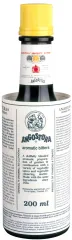
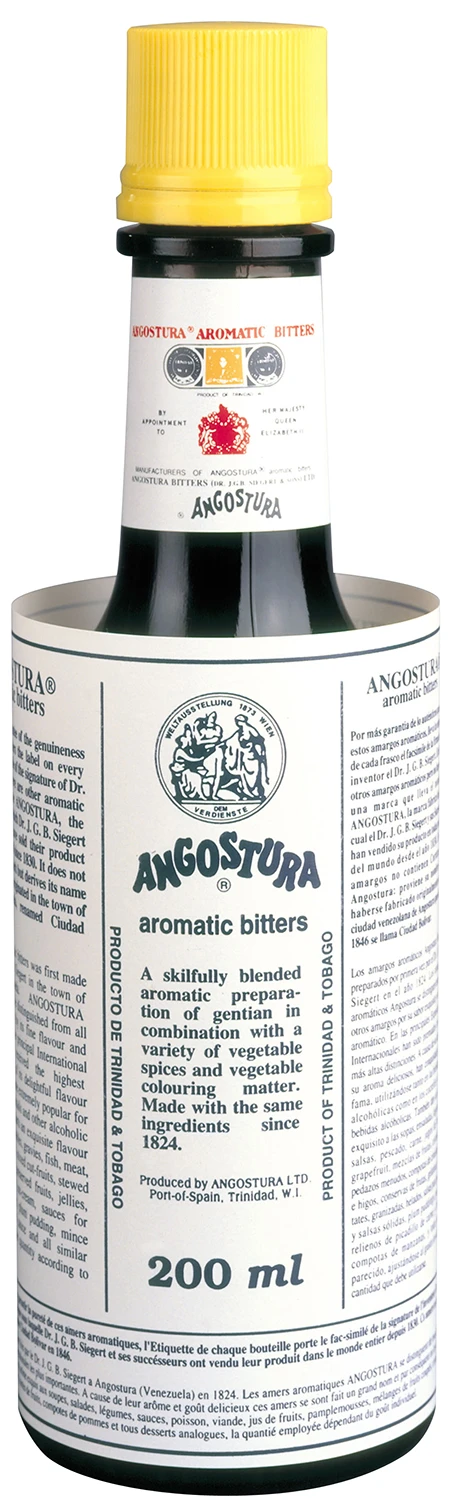
Angostura aromatic bitters is a concentrated aromatic bitters produced by the House of Angostura in Trinidad and Tobago, based on gentian, herbs and spices. Angostura bitters is a concentrated bitters (a herbal alcoholic preparation) based on gentian, herbs and spices, produced by the House of Angostura in Trinidad and Tobago. The bottle is recognisable by its distinctive, oversized label and yellow cap.
The recipe dates back to 1824. Siegert composed a tincture of gentian root and a closely guarded list of botanicals as a remedy for the stomach ailments of Simón Bolívar's soldiers – which is why the product is still called "aromatic bitters" and has nothing to do with the angostura tree. It began as a medicine and became a bar classic. By 1875 the family firm House of Angostura had moved to Port of Spain in Trinidad, where the bitters is produced to this day. It is known to be a blend of more than 40 different herbs, spices and botanicals infused in high-ABV alcohol. The exact composition remains a closely guarded secret, known only to a small handful of people.
The bottle is 44.7% ABV. Angostura bitters is extremely concentrated and can be an acquired taste; although it is 44.7% alcohol, it is not usually consumed undiluted, but used in small amounts as a flavouring agent. The profile is dominated by warm spice notes – gentian, cinnamon, clove, cardamom. The blend of fruits, spices and herbs creates a classic aromatic flavour with pronounced warm spice notes, especially clove. The producer describes it as a bouquet of herbs, fruits and spices, with a reddish-brown hue.
It is an ingredient in many classic cocktails. The brand has dominated the aromatic bitters category for almost two centuries. When a cocktail recipe says "bitters" without further specification, it almost always means Angostura. Other categories – orange bitters, Peychaud's, mole bitters, chocolate bitters – are explicitly named; "bitters" on its own defaults to Angostura. A few dashes are added to an Old Fashioned, Manhattan, Pink Gin or Champagne Cocktail, as well as to dishes, marinades and desserts. The alcohol content of 44.7% is its own preservative – the bitters does not "go off" in any meaningful sense, even past its best-before date. The bottle should be stored upright, at room temperature, away from direct sunlight. Refrigeration is unnecessary and not recommended (cold thickens the bitters and makes it harder to dispense cleanly).