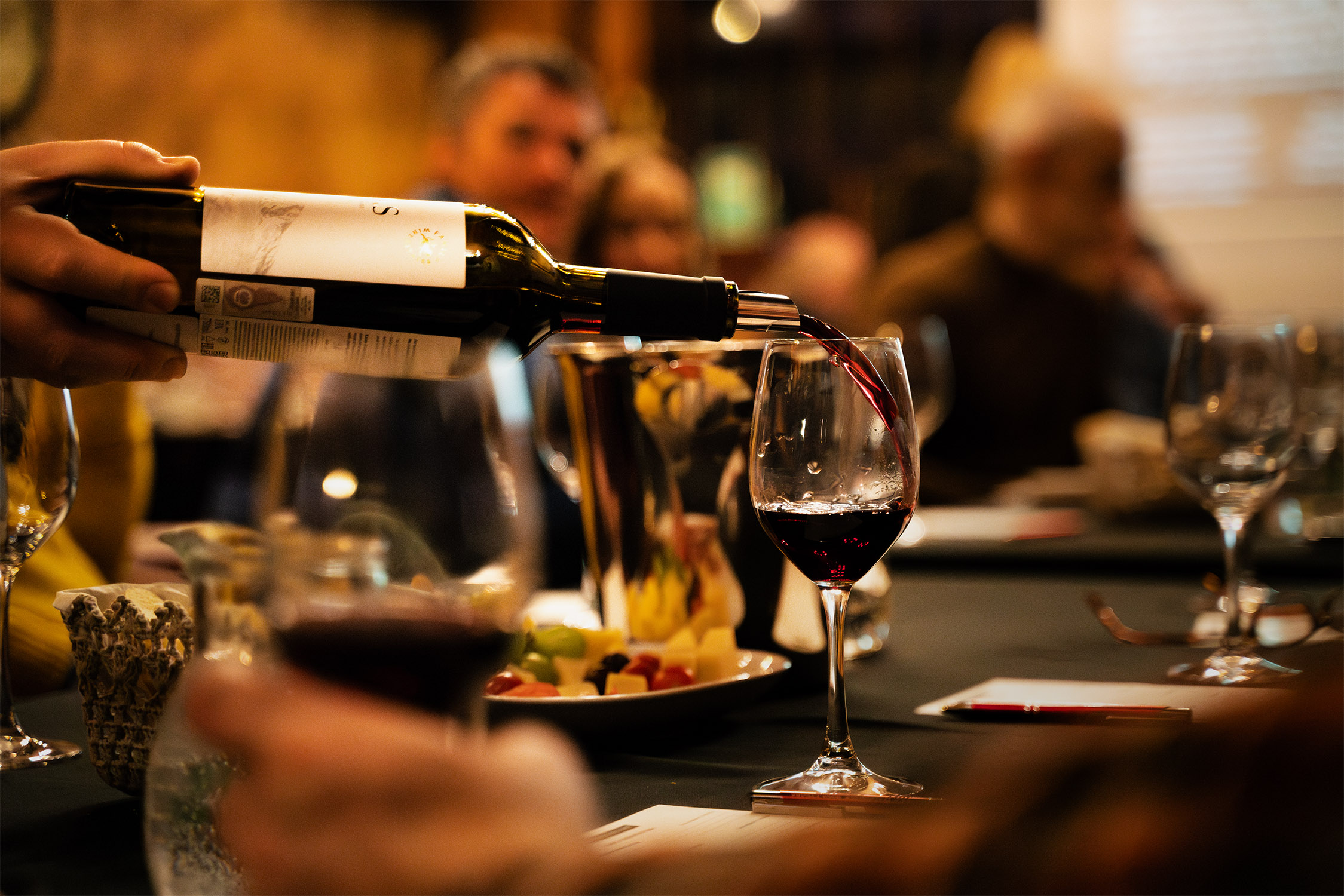
Wine can be drunk and drunk. Or rather drunk and tasted. And there's not a shred of snobbery in this. Proper tasting is about being able to appreciate wine, to make use of its potential. Because without the ability to taste properly, it makes absolutely no difference whether we drink a young Rioja for 30 zloty or a grand reserva for 230 zloty. When we don't know how to appreciate good wine, we have no need to buy and try such wine. But then we also don't know how much we're missing out on.
5 Steps of Professional Wine TastingWhat will you learn from this article?In this article, I will present the correct wine tasting techniques step by step. I will tell you what to pay attention to, how to develop your senses, and share experiences from our tastings.💡 In 2025, we conducted over 300 guided tastings, including 25 exclusive masterclass tastings, attended by people of varying levels of knowledge – from beginners to advanced wine enthusiasts.What's the difference between tasting and simply drinking wine?What is wine tasting?Wine tasting is the conscious use of your senses while drinking. Through sight, we assess the color and clarity of the liquid. Through smell, we identify aromatic notes. In the mouth, we recognize taste, pay attention to structure, acidity, tannins, and observe how long the taste remains in the mouth after swallowing.Why is it worth learning to taste wine?This sensory reception allows you to become aware of the wine's quality and derive full pleasure from drinking it.Who engages in professional wine tasting?Two groups of specialists: oenologists and sommeliers.Oenologists oversee wine production from vineyard to bottle. They evaluate wine at every stage – from fermentation, through barrel aging, to bottling. Their assessment determines when the wine is ready. They need both technical knowledge of winemaking and highly developed senses of smell and taste.Sommeliers are wine experts you'll meet in restaurants, where they pair wines with menus. They also work in import companies, specialized wine shops – such as M&P – and conduct tastings. They help customers find the perfect wine for every occasion.What do you need for wine tasting at home?When organizing a wine tasting at home, you need to take care of several technical matters. Below you'll find tips on what to prepare for a successful home tasting.What glasses to choose for tasting?Glassware for tasting is the basic thing to take care of (besides the wine itself, of course). This is fundamental because the shape of the glass affects the concentration of aromas, so if we want to identify them correctly, we must have appropriate tasting glasses. The shape of the glass bowl also determines how wine flows into our mouth, which in turn affects how we perceive it.Red wine glassesThe specifics of red wines – especially complex, heavier, long-aged ones – require a glass with a wide and tall bowl that narrows toward the top. Tasting red wine in such a glass will allow the flavors and aromas of the wine to be released, thus revealing its full potential.White wine glassesWhite wines are not as demanding because they are less aromatically complex than red wines. White wine glasses are therefore usually smaller and narrower. It's also important that white wines are typically served at a lower temperature – a smaller bowl helps maintain it longer.Sparkling wine glassesSparkling wine is served in slender, tall, and elongated glasses. This is important because sparkling wine has bubbles, so we want them to remain in the glass as long as possible. The long, slender bowl is also responsible for ensuring the wine's taste is perceptible in the right place on the tongue, which affects its perception.Dessert wine glassesDessert wine is most often served in glasses with a small bowl on a shorter stem. This is because dessert wines are generally sweeter and stronger, so the glass can be smaller in volume.Universal wine glasses – are they a good choice?If you're just beginning your adventure with home wine tasting, you don't need to buy a whole set of glasses right away. You can complete your collection gradually. At the beginning, universal glasses that narrow toward the top will suffice – this is important because this glass shape allows aromas to accumulate. Over time, you can supplement your collection with separate glasses for red wine, white wine, sparkling wine, or dessert wine glasses.What wine temperature is ideal?Wine temperature is a fundamental factor in successful tasting – equally important as the right glass – because it has crucial significance for bringing out the taste and aroma of wine. Information about wine serving temperature can often be found on the bottle's back label. If there's no such information, follow these guidelines:Wine Type | Temperature | Examples
Sparkling | 5-9°C | Champagne, prosecco
Light white | 7-10°C | Sauvignon blanc, pinot grigio
Full white | 10-13°C | Chardonnay
Rosé | 8-12°C |
Light red | 12-16°C | Pinot noir, gamay
Medium red | 15-18°C | Merlot, tempranillo
Full red | 16-18°C | Cabernet sauvignon, syrah
Dessert | 6-14°C | Depending on colorDo you need special accessories?Besides appropriate glasses, you'll also need a wine opener or corkscrew.How to choose wine for home tasting?It depends on the expectations and knowledge level of participants. At first, ask for advice from a consultant in a specialized shop.The order of tasting is crucial – we start with the lightest wines and end with the heaviest. If you don't know wines well, it will be difficult to arrange them yourself.💡 Visit one of the 54 M&P Alkohole Wina Cygara shops. In each of them, you'll find trained advisors who will help you prepare a tasting set for any occasion.How to taste wine step by step – complete guideSTEP 1 – Sight: How to assess wine visually?In the visual assessment of wine, the most important thing is to identify the color of the liquid, its intensity, shade, and clarity.How to properly hold a glass during visual assessment?During visual assessment of wine, hold the glass at a 45-degree angle. It's important that we can assess the wine's color against a white background to see it accurately. At this stage, the lighting in the room where we're tasting wine is very significant. If it's too dark, we won't be able to properly assess the wine's color.What does wine color tell us?By observing wine color, you can assess the wine's age and structure with high probability.Red wines with intense color are generally younger, while older ones take on paler, brick-like, brownish colors.Young white wines have a light, straw color, often with green reflections. Mature white wines are golden, amber.What do "tears" on the glass mean?Tears on the glass are an effect we get after swirling wine in the glass. The liquid then settles on the walls, forming drops – more or less dense – that flow downward. And based on the density of tears on the glass, we can draw certain conclusions. Dense, slowly flowing drops may indicate that the wine has higher alcohol content or that it's sweet.Remember that this effect is not an indicator of wine quality, but merely a hint or characteristic of the wine that we note during assessment.STEP 2 – Smell: How to recognize aromas in wine?After visual assessment of wine comes time for aroma assessment. Remember that the ability to recognize aromas in wine develops with experience – the more you practice, the better you'll be able to detect them.How to properly smell wine?Most important: don't rush. This is a stage that requires time and your concentration.Smell in three steps:First breath – before swirling
Pour wine into the glass, immerse your nose and breathe calmly. These first aromas are often the most delicate.Second breath – after swirling
Rotate the wine in the glass. Contact with air releases deeper aromas – fruits, spices, barrel notes. This is where you'll discover the most.Third breath – empty glass
After drinking the wine, smell the empty glass. Often aromas remain that you didn't detect earlier.💡 Close your eyes while smelling. Your brain will concentrate better on smell when you turn off the sense of sight.How to recognize individual aromas?Recognizing aromas in wine is a relatively difficult skill requiring constant practice. The most common problem among people learning this is the situation where "yes, I know this smell, I recognize it, but I can't name it." In this situation, a tool comes to help – the aroma wheel. This is a circle-shaped diagram containing categorized scents, which makes their identification in wine easier.💡 If you want to learn to recognize aromas in wine, smell various things. Use opportunities while cooking, smell fruits, vegetables, herbs, but also flowers on a walk. Generally, good advice is to stop for a moment whenever we smell something at any time of day and try to identify and name it.Most common aromas in popular winesAroma characteristics can also be helpful in finding aromas.Often on the wine's back label, we'll find its description including aromatic profile. We can also look for useful information on the product page in the shop where we bought the wine, as well as on the producer's website. Once we know what to look for, it's easier for us to find it and remember it.Knowledge of individual grape variety characteristics is also helpful. For example, knowing that our wine is made from cabernet sauvignon, we can be certain we'll find black currant aromas in it, and we might also smell notes of bell pepper or cedar. In chardonnay from a cool climate, we'll find aromas of apple and citrus, while chardonnay produced in a warm climate will delight with rich aromas of tropical fruits – peach, banana, mango.Besides the basic varietal characteristics, we should also think about where the wine comes from, because the terroir in which the grapes ripened has a significant impact on the aromas that will develop in the wine.What is a bouquet in wine?A bouquet in wine is a collection of aromas that develop at different stages of its production. It's therefore a unique composition of aromas that we can smell when sniffing wine in a glass.If we can smell many aromas, we'll assess the wine as more complex. Bouquet assessment in wine allows sommeliers to identify wine and assess its character.Go from general to specificYou don't have to hit the bullseye right away. Nobody starts with "aha, it's red currant from northern France."Often the process looks like this:First breath: fruity
Second breath: red fruit
Third breath: something like cherry... or maybe sweet cherry?
After a moment: actually more like red currantThis is a normal path. Even sommeliers go through this process – they're just faster because they have more practice. With each consciously tasted wine, you'll also be able to perceive more and more nuances faster.STEP 3 – Taste: How to assess wine taste?After visual assessment of wine in the glass and aroma identification, we can proceed to actual tasting, which is discovering the wine's taste.How to taste wine?To consciously taste wine, take a small sip and spread the liquid throughout your mouth so it reaches all receptors. Then we need to focus on what we actually feel. Before taking a sip of wine, it's also worth swirling the wine in the glass to aerate it additionally.What elements do we assess while tasting?For the purpose of analyzing and assessing wine taste, it's worth creating a system for recording flavors. This can be done using a scale that has extreme sensations marked at opposite ends, e.g., sweet – dry.It's also worth assessing the degree of acidity, tannicity, alcohol, and structure.What is tannicity in wineTannicity is the feeling of astringency and dryness in the mouth caused by tannins present in wine. Perceiving them has a significant impact on the perception of the wine's structure and complexity.What is structure in wineWine structure is the overall impression we feel when we have wine in our mouth. We can perceive wine as light, having little body, airy, delicate. We can also feel that the wine is full, dense, has a lot of body. When describing structure, we can also describe wine as medium body – not too light, not too heavy, just right.STEP 4 – Finish: How to assess wine's aftertaste?In the process of analyzing and assessing wine, we also pay attention to the finish, which is the flavor impression that remains after swallowing (or spitting) the wine.How long should a wine's finish be?We assess wine finish in terms of its length, so it can be short, medium, or long. Besides its length, we also assess its character, meaning we can say what flavors we detect and whether they are pleasant to us.What does the finish tell us about wine quality?The finish can tell us about the quality of wine we're dealing with. If the finish is long and pleasant, it's a sign for us that the wine is characterized by high quality. And it's even better if we additionally feel developing aromatic notes in the finish, which is called a "peacock's tail."STEP 5 – Synthesis: How to assess wine holistically?The final stage is summarizing and evaluating the wine. It's about summarizing your tasting impressions, taking into account all the sensations we analyzed in the previous four steps. We can assess, among other things, the wine's complexity, balance, and we can say whether the wine is harmonious. Ultimately, we can give the wine a rating on some adopted scale.💡 If you're planning a wine tasting, refrain from wearing perfumes, smoking cigarettes before and during tasting. Also make sure that meals before tasting are mild so they don't interfere with analyzing and assessing the tasted wines.How to learn to taste wine?Wine tasting is, contrary to appearances, a difficult art, but it can be learned. The ability to taste correctly and develop in this field brings much satisfaction.Can you learn tasting on your own?Yes, you can learn tasting on your own, like any other skill. However, in home conditions, it's definitely more difficult.It's always worth having someone nearby who will help you discover, suggest where to look for answers, and share knowledge.There's also a practical and economic issue – purchasing wines for tasting. To try a given wine and evaluate it, you don't need a whole bottle.It's much more convenient to have company for learning. You can share wine, open several different bottles, compare them, discover, talk. This is the essence of tasting – a passion that creates a community.Why is it worth participating in professional tastings?Professional guided tastings provide invaluable opportunities. The presence of a specialist who shares knowledge. Proper selection of wines from different price ranges. The ability to try different types and styles.But also conditions for free conversation with other participants. These are just some of the benefits of participating in a professional tasting.What will you learn at a guided tasting?During a professional guided tasting, you'll learn how to taste wine from the basics. You'll learn proper tasting techniques, notice and eliminate mistakes, get to know other participants' perspectives, and gain substantive knowledge about wine regions, grape varieties, or the wine production process.💡 Most often we discover aromas together. Someone says: "This reminds me of childhood, such a red fruit from a bush at grandma's." Someone else suggests: "Red currant?" And suddenly everyone: "Oh yes! That's it!"That's why group tasting is so valuable – together we name what we feel faster. Don't be afraid to think out loud. Your association might be the key for someone else.The biggest barrier is in your headIf you think you need to come to a wine tasting already with knowledge – I have good news: you don't.Most common concerns of beginners:"I'll look weird smelling wine like that"
"What if I'm wrong and say something stupid?"
"Everyone will know more than me"The truth is: nobody's judging you. Tasting isn't an exam. It's training your senses, discovering together. If you feel the wine smells like grass to you – say it. If someone else smells citrus – that's also good. Both answers are correct because they're your personal perceptions.Wine tastings at M&P – how does it work?Throughout the M&P Alkohole Wina Cygara network, guided tastings are organized for customers. They take place in specially prepared tasting rooms in M&P shops, but also in venues we cooperate with.To participate in such a tasting, simply purchase a ticket for the event and come at the designated time.What types of tastings does M&P organize?Various tastings take place in the M&P Alkohole Wina Cygara network. The theme can be a given producer, wine region, grape variety, wine type, or new products in the offer. Our specialists conduct them.Most often tastings focus on getting to know wine, so the tasting package includes wines and appetizers. However, we also organize dinners with food pairing, where in addition to getting to know the wine itself, we discover in practice how it pairs with dishes.Yet another unique type is masterclass tastings. These are meetings conducted by winery representatives who present their wines and share first-hand knowledge. These events are extremely interesting because they're supplemented with stories directly from where the wines are produced.How to prepare for your first tasting at M&P?You don't need to specially prepare for a guided tasting. Just sign up, buy a ticket, and come.What's worth paying attention to are factors that interfere with tasting. Smoking cigarettes before or during tasting, using too strong perfumes, or a meal with too strong a taste before tasting can interfere with the perception of wine's taste and aroma.How much does participation in a wine tasting cost?The ticket cost for a tasting depends on what wines will be in the tasting package and whether it's a tasting with food pairing, because then the price also includes the cost of dishes. The price of such a basic tasting starts at 50 PLN per person and includes five portions of different wines to try.Start your adventure with wine tastingProper wine tasting is a skill that changes the way we drink wine. Instead of simply "liking" or "not liking," you begin to understand why you like a given wine. You recognize aromas, identify structure, consciously choose bottles for specific occasions.You don't have to learn this alone. In the M&P Alkohole Wina Cygara network, we regularly organize guided tastings – in 2025 we conducted over 300, so we know how to effectively guide participants through the world of wines.Your first step:At home? Buy 3 different wines (white, rosé, red), prepare glasses, and conduct a home tasting using the tips from this article.With us? Check the M&P tasting calendar and join the nearest meeting in your city.Frequently asked questions about wine tasting (FAQ)Do you have to spit out wine during tasting?You don't have to spit out wine during tasting, but you can. It all depends on you. Consider how much wine you plan to try and what your tolerance is.Can you taste several wines in a row?You can, but remember the proper order. So we start with lighter, more delicate wines, and end with serious, heavy, full-bodied ones.What if I don't feel all the aromas described by experts?Don't worry about it! Learning to taste is a process. With each consciously tasted wine, you'll be able to detect more and more nuances.How long does a professional guided tasting last?It all depends on the tasting plan, the host, and also the participants. Sometimes interesting conversations develop during tasting that extend it slightly. However, you should reserve at least 1.5 hours.Do differences in glass shape really affect wine taste?Yes, glass shape has a real impact on wine perception. A wide bowl allows the wine to "breathe" and concentrates aromas at the glass rim, allowing us to detect them better. The edge shape also directs wine to specific parts of the tongue – this affects which flavors we perceive first. It's not snobbery or marketing – it's physics and physiology.Why does the same wine taste different during lunch and dinner?Your senses change throughout the day. In the morning, you're more sensitive to acidity, in the evening you better perceive sweetness and tannins. Room temperature, air humidity, and food you ate earlier also affect wine perception. Even mood and fatigue change flavor perception.Does more expensive wine always mean better?No. Wine price depends on many factors: region of origin, vintage, producer reputation, production costs, and sometimes simply marketing effectiveness. A wine for 50 PLN may be better suited to your preferences than a wine for 200 PLN. What counts is quality and fit to your taste, not just the price on the label.How long can you store an opened bottle of wine?White and rosé wine: up to 3 days in the refrigerator with a cork. Red wine: up to 5 days in a cool, dark place. Sparkling wine: maximum 2 days with a special sparkling wine stopper. After this time, aromas fade and the wine loses freshness, but it's not spoiled – you can still use it for cooking, for example.
-copy-webp.webp)